|
- Dr. Charles Roscoe Meek
- Written by his son, Charles Jackson Meek
|
|
|
|
|
|
 |
|
Dr. Meek was born on a farm near Holbrook in Greene County, Pennsylvania on February 13, 1887. His father was Cephas Jackson Meek and his mother was the former Nancy Jane Loar. He was a large baby, big-boned, as was evident throughout his life. He seems to have inherited his physical type from the Loar side of the family who were all hefty people. As an adult, he weighed about two hundred twenty pounds and was strong and muscular with large hands and fingers. After his death, I received his Masonic ring, which fit easily over my thumb.
|
|
|
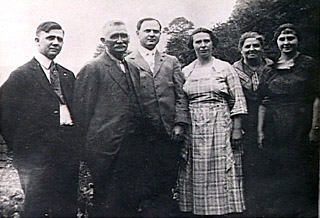
James, Cephas, Charles, Velma, Nancy Jane, Hildred
|
|
|
 |
|
|
|
|
|
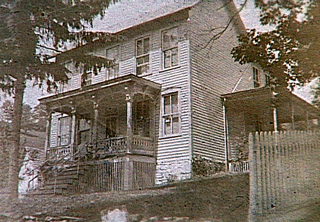
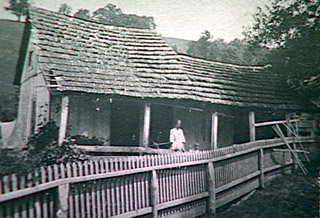
When Dr. Charles was born, his grandfather, James, lived in the big farmhouse, while his father and mother occupied the smaller cabin-type structure about fifty feet away. The cabin was insulated with newspapers attached to all the walls. At the age of four, Papa became curious about all the letters in the newspapers. Grandma Meek taught him the meaning of the letters and, by six years of age, Papa had become an accomplished reader.
|
|
 |
At the age of six, Papa started school in a small one-room schoolhouse about two miles from home. He was an excellent sportsman, one of the best baseball players in the area. However, he was nearsighted. On several occasions when he and his father and brother James would go out hunting, his father would see a rabbit over near the woods and tell Papa to shoot it. Papa could not see the rabbit, of course, but raised his rifle in the direction indicated and shot, missing the animal. Uncle Jim always thought Papa was a very poor shot.
|
|
When he was about nine years old, he was baptized at the church that his Grandfather Loar had started near Wind Ridge. The beautiful old church still served the community. All the children were immersed totally in the river running alongside the church. It was the dead of winter and extremely cold, but Papa said none of the children caught cold or flu even though they had to return more than three miles by horse and wagon to reach home again.
|
|
He was a prize student and graduated from high school at the age of fifteen. From the age of twelve, he ran the farm for his father and did most of the chores. His brother James, four years younger, could not do much work on the farm, being of much slighter build and not nearly so strong. Papa later told me that Grandpa’s horses and other animals never showed a scratch because Grandpa always kept slices of cantaloupe exposed, lying on the ledges of the barn where they accumulated mold. When an animal got a scratch or cut, Grandpa would strap a piece of cantaloupe to the injury and, lo and behold, it would heal and show no sign of having been injured. Papa later determined, after he received his medical degree, that the mold must have been a natural form of penicillin, scientifically unnamed in those early days.
|
|
|
|
|
 |
|
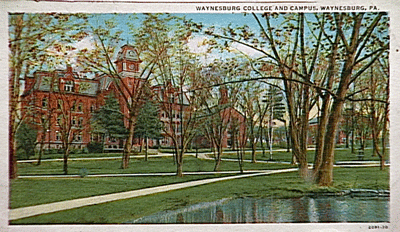
As soon as he graduated from high school, he rode a horse into Waynesburg, twelve miles away, to attend business college. His father had called his children together and declared that he would send all of them to college if all wanted to go, but that if even one was uninterested in attending college, he would send no one. Velma, the oldest, and the two younger children, James and Hildred, hadn’t the slightest interest in college. Consequently, Papa received no help from his parents in pursuing an education.
|
|
|
|
|
|
Waynesburg College Campus
|
|
|
|
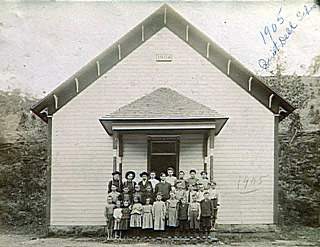
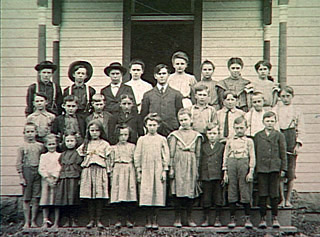
He realized that, if he were to attend college, he would have to earn his own way. So, at sixteen, he acquired a permanent Pennsylvania teacher’s certificate and started to teach in the country school that he had attended as a student. Since his brother Jim was one of his students, they shared the wagon ride to and from school. Now that he was earning some money, Papa enrolled in Waynesburg College. Teaching five days
|
|
 |
|
|
|
 |
|
a week in the country school left him only Saturdays in which to attend college classes. However, Papa did all the week’s work in one day and received two year’s credit at the college. It was at this time that Papa met Nettie E. Waychoff and fell in love.
|
|
|
Charlie, teacher (center), 1905
|
|
|
|
|
|
 |
|
|
|
At eighteen, Papa needed more money, so he got a job counting railroad cars on the Pennsylvania Railroad, writing down the car numbers as the train passed by. He was stationed at Pitcairn, PA. He decided he needed a better job, however, so he paid an employment agency to find him a better one and gave the agency his address on the farm. One weekend, he returned to the farm and inquired if he had received any letters. Aunt Velma said yes, one had come from some fly-by-night company in Pittsburgh about a job, but she knew Papa had a good job, so she destroyed the letter.
|
|
| Accumulating some money, and borrowing $ 1,000.00 from his Uncle James, who lived just across the hill from the farm, he decided to seek admission at a medical school. He was admitted to the University of Pittsburgh. During the first week, a professor stopped him in the hall and said, ”You look like a |
|
|
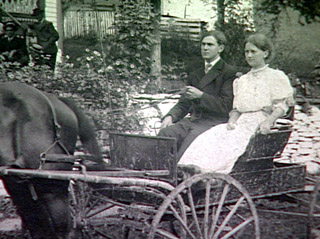
Charlie and Nettie, 1908
|
|
|
promising young student, so I will recommend to you that you do not attend medical school here at Pitt, for we have a very low rating. However, next week, Starling Medical School in Columbus, Ohio is matriculating. It is the finest medical school in the country. My advice to you is to enter Starling immediately.”
|
|
|
 |
|
Papa didn’t need any more advice and left for Columbus right away. He graduated from the Starling Medical College in the spring of 1913. That same year, Ohio State University took over Starling Medical College, so Papa really graduated from the Ohio State Medical School.
|
|
|
 |
|
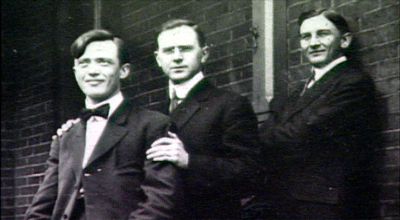
- Dr.'s McVey, Meek & Sommer
- "The Great Trio"
|
|
While he was at medical school, Papa diagnosed his own eye problem. The eye doctors had always told him he was far-sighted, but he found out he was really nearsighted with overcompensating eyes. He wrote his own prescription and got the right kind of spectacles. From then on, Papa became an expert rifleman and won several sharpshooter awards. I went with him one day to a farm near Lorain where Papa wanted to get a chicken to take home and cook. The farmer had more than a hundred chickens running around his barn in a large enclosure. Papa wanted the big rooster standing in the middle of the flock, but the farmer said he couldn’t have him because no one was able to catch him. Papa asked the farmer for a rifle and proceeded to shoot. The rooster zipped around the corner of the barn and the farmer claimed that Papa had missed him. Papa insisted that he had hit him right through the head and told the farmer to go around the side of the barn to pick him up. Sure enough, the farmer returned with the dead rooster.
|
|
|
|
 |
|
|
|
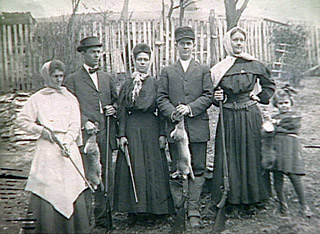
Oma, Frank, Velma, Charlie, Nettie, Hildred
|
|
As an additional way to help pay for medical school, Papa sold books during three summers. He walked all around southern Pennsylvania, up and down the country roads with his books. He practiced turning to special pages by feel so he could illustrate his sales pitch. For instance, at a farm house, he would talk about the neighbors at the next house down the road, asking their names and how many chickens they had and how many eggs they would get each morning. Then he would greet, by name, the farm lady who might be sitting on the front swing. If she could not read, he would open up the books and show her how wonderful it would be if she had several of them. She could then open them up while she sat on the swing and pretend to read. Certainly, that would impress her neighbors. Or he might say that, by selling only so many eggs each day, it would be very easy to pay for the books. The third summer, he became a Supervisor and was rewarded for the efforts of four or five salesmen under him.
|
|
At medical school, he took courses in Internal Medicine, Surgery, and Psychiatry. During his years of medical studies, he learned to like tobacco for a very pragmatic reason: the cadavers the students worked with were held in formaldehyde so that, in order to counteract the odor and settle their stomachs, even the female students chewed tobacco.
|
|
While still a student, he practiced with indigent patients in Columbus and did quite a bit of work with the mentally ill. On his final exam, he was given a mentally disturbed man to analyze. For almost two hours, Papa asked the man all sorts of questions, but the man answered all of them in a most sane manner. Papa figured he had been given a ringer. Just before the time was up, Papa asked the subject what he would do if they sent him home. The man replied that first he would get a shovel. “Why?” “So I can dig a hole to China.” Papa passed.
|
|
|
|
|
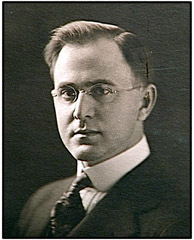
- Upon graduation from medical school, various companies offered Papa the opportunity to join their medical staff. Among them, the National Tube Company, a division of U. S. Steel, sent representatives from their plant in Lorain, Ohio. They needed a surgeon, but Papa was unimpressed by the representatives. That evening, for the first time in many months, he went to a movie. Medical school was so intensive that he had not had any time to relax for a long while. In those days, movie shorts were offered between the comics and the main movie, usually with the news of the day. One of the shorts featured the steel pipe mill at Lorain, Ohio. The news feature changed Papa’s mind and the next day he accepted the position as Surgeon at the National Tube Company.
- (Photo at left was taken in 1913)
|
|
 |
|
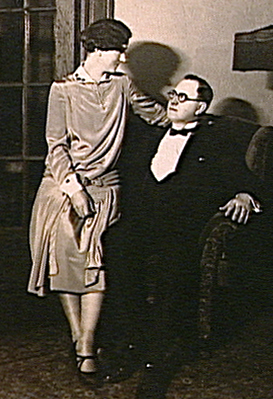
The doctors were located on the third floor of the General Office Building at the end of Pearl Avenue. They were expected to be available twenty-four hours a day and to live on company property. In addition, there was a rule that the steel plant doctors could not be married. Because he was in love with Nettie, he resigned. They were married in Waynesburg on August 13, 1913. He did not return to work as a regular doctor at the steel company even though three months later the company rescinded the marriage rule. He did return twice, however, to be employee examiner, once in the late 1930’s and again in the early 1950’s.
|
|
|
|
|
|
|
|
 |
|
|
 |
|
Papa started private practice using a horse and buggy. He rented a house at 445 East Erie Avenue, located just east of the bascule bridge on the northwest corner of East Erie and Colorado Avenues. The house, which was attached to the west side of Bin’s Grocery store, sat back from the street and was across from Brown’s Pharmacy.
|
|
|
|
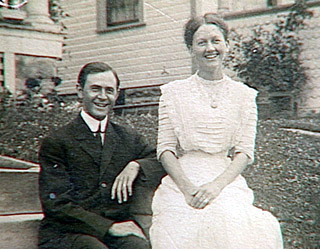
Charlie and Nettie, 1913
|
|
|
| Shortly after his resignation from the National Tube Company, he became Chief Medical Examiner of the Lorain Public Schools, a position he held from 1913 until 1919. He hated the athletic accidents that incapacitated young people, sometimes for life. During this time, Papa found many students with lice in their hair. This concerned him and caused him to inform the parents on how to treat the problem. A reporter for the Lorain Times Herald, owned by |
|
|
Hamilton Ave. Home
|
|
Mr. Hoiles, found out about it and wrote a scorching article reprehending the school doctor. Papa did not like Hoiles very much from then on; nonetheless, he did not allow his feelings to interfere with the close friendship I developed with Harry Howard Hoiles, who was only eleven days older than I. The Hoiles family lived only a block away on Hamilton Avenue after we moved, but, in 1928, Mr. Hoiles sold the newspaper and moved to Mansfield where he owned the Daily News. Mrs. Hoiles came to Lorain for several summers thereafter to take me to Mansfield for a week to be with Harry, which I enjoyed very much.
|
|
At 10:00 a.m. on Sunday, February 6, 1916, a boy was born to Nettie at St. Joseph’s Hospital. Papa said the boy weighed 8-1/2 pounds, but Mamma felt the baby was closer to 10-1/2 pounds. It was reasonable that Mamma thought I weighed more because she said, looking into the bassinet, she could not imagine that great big boy coming out of her. Since Papa’s name was Charles and the two grandfather’s middle names were Jackson (Cyphus Jackson Meek and Andrew Jackson Waychoff), it seemed natural to name their son Charles Jackson.
|
|
In the summer of 1917, Papa bought the house at 544 Hamilton Avenue. It was the home in which he lived until his death in 1958. The house was conveniently located just three blocks from Broadway, the center of Lorain’s business district, and one block from Lorain High School.
|
|
|
|
 |
|
|
|
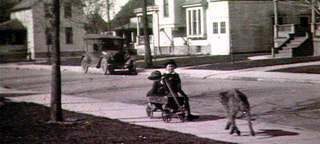
Soon after the move to Hamilton Avenue, Papa and Mamma joined the Congregational Church and sang in the choir for a while. Mamma had a very nice soprano voice, but she sang little in later life. Papa had a rich low baritone quality and loved to sing the old hymns and songs he remembered from childhood. Years later, he sang bass in my SPEBSQSA chorus.
(Photo at left taken about 1920 on Hamilton Avenue)
|
|
|
Charles Jackson, Cemantha Jane and Jim (dog)
|
|
|
Soon after the move to Hamilton Avenue, Papa and Mamma joined the Congregational Church and sang in the choir for a while. Mamma had a very nice soprano voice, but she sang little in later life. Papa had a rich low baritone quality and loved to sing the old hymns and songs he remembered from childhood. Years later, he sang bass in my SPEBSQSA chorus.
|
|
He had many dreams, frequently about medical problems with which he was dealing. When the dreams provided solutions to his patients’ problems, he would come down the stairs in the morning singing this song at the top of his lungs:
|
|
|
|
|
 |
|
|
|
Up
|
in
|
|
the
|
morn-ing
|
- at
|
break
|
of
|
day,
|
|
Out
|
in
|
the
|
|
|
|
 |
|
|
|
mead-ow
|
|
to
|
rake
|
the
|
hay.
|
|
|
|
Up in
|
|
the
|
|
morn-ing
|
|
and
|
|
|
|
are
|
|
|
|
 |
|
|
|
gay,
|
we
|
whist - le
|
and
|
work
|
|
a -
|
way,
|
|
Oh,
|
|
we
|
whist-le
|
and
|
|
|
 |
|
|
work
|
|
a -
|
way.
|
|
|
|
|
|
|
|
|
|
|
|
|
|
|
|
|
|
|
|
|
|
|
|
|
|
|
|
|
|
|
|
|
|
|
|
|
|
|
|
|
|
|
|
|
|
|
|
|
|
|
|
|
He sang when he dreamed that his women patients should get up and move around as soon as possible after childbirth, when the common practice of the time was to keep new mothers confined to bed for a week. He sang when he realized that newborn babies should not be placed in oxygen tents (which we now know can damage their eyesight), but should, instead, be given warmed, filtered, pure air to breathe. He sang when he dreamed of creating a new, better baby formula for his smallest patients. The loudest I ever heard him sing was during the morning after he dreamed about three patients who suffered from anemia. Mamma asked him why he was so happy this morning and he replied that he had seen his three patients eating raw liver in his dream and realized they needed more iron. This was, I think, 1922, before preparations of liver extract were commercially available. Years later, when he was surrounded by his little grandchildren and was feeling particularly jolly, he sang this and other favorite tunes, and also played the piano, to entertain them.
|
|
In 1921, I caught the flu from Mamma, who had the flu almost every year. When it turned into pneumonia, Dr. Adair told Mamma to put me in the downstairs bedroom, keep the window and door closed, and draw the blinds to keep me in the dark. When Papa returned from his own medical calls, Mamma told him that my condition seemed to be getting worse. Papa came in and opened the window and door for fresh air, insisting that I had been breathing in all my own germs. My health improved immediately. Papa’s intuitive nature was joined by strong common sense to help him succeed in his medical practice.
|
|
Dr. Valloyd Adair had been Health Officer until the war started in 1917. When he left for the military, Papa was appointed Health Officer to take his place and served from 1918 to 1920. Papa also became the examining physician for the men entering the military. He did the examining also during the Second World War. He developed an exam procedure which included touching the nose while the eyes were closed, standing on one leg with eyes shut to test balance, etc., which Papa said was later adopted by the military, and was once called the Meek Method. He used this method to examine as many as one hundred men in one day.
|
|
While serving as Health Officer, Papa noticed that the many public drinking fountains in downtown Lorain provided only a single, common drinking cup for each fountain. As various people drank from the same cup, they passed along their diseases. Papa required valves to be put on the fountains to provide free-flowing water. This health law was one of the first of its type to be required in any of the cities in the United States. During the flu epidemic of 1918, Papa served as Director of all Emergency Hospitals in Lorain. From 1920, he served as Chairman of the Public Relations Committee of the Lorain County Medical Society.
|
|
|
 |
|
|
|
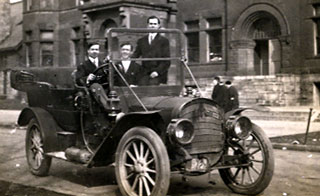
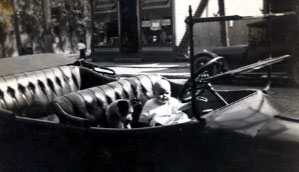
In 1917, Papa bought a Saxon automobile that was completely open except for a roof. If it rained, the flaps on the sides could be dropped to keep the rain out. About 1920, he exchanged it for a Reo, keeping it for four years, and then bought another Reo in 1924, just before the disastrous Lorain Tornado in June. The car ran well almost everywhere, except when we returned from a trip to Niagara Falls, Waynesburg, or other longer distances. It seemed that, as soon as we hit the Lorain City line, the axle would break and we would have to be towed to the garage. Axles, in those days, were not made of high tempered alloy steel. Papa was used to troubles and just quietly said, “Well, there goes another axle.”
|
|
|
Cemantha Jane & Spot in the Saxon
|
|
|
 |
|
|
|
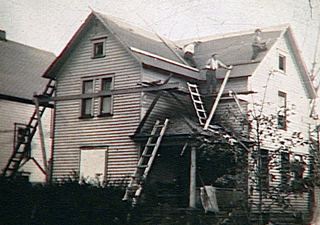
After our house was repaired following tornado damage (we had stayed with the family of Papa’s favorite nurse, Mr. and Mrs. Vorhees, for several months), Papa decided that he needed a second car in case one of them did not start when he had an emergency. So he bought a 1924 Jordan Landelei Coupe--the first car manufactured with balloon tires and a solid aluminum body. Only 300 of these cars were manufactured. It had a Continental engine, two wheel brakes, a trunk in back and an imitation of a horse-drawn coach type body with two small lights on each side near the floor beside the feet. Each ventilator could be opened with a screw type of elbow that secured the ventilator in any position.
(Photo at left: the Hamilton Avenue house as it appeared in 1924)
|
|
Ohio was one of the first states to have paved roads, but, for a number of years, the paving was only on one side of the road. Everybody drove down the paved side so long as no one else was coming the other direction. If the paving were on the left side, the driver would have to move over to the mud side of the road to allow another car to pass, and then, after passing, to re-enter the paved side again. If the paved side were on the right, the approaching car would have to move over. It wasn’t very pleasant when it was raining. When we got into Pennsylvania, however, all the roads were mud and would be terribly rutted if there had been a recent rain. The deep ruts were hard on the axles and springs, even though the car bodies were set very high above the wheels. When we approached a stream that ran across the road, we needed to build up a little speed to avoid getting stuck.
|
|
|
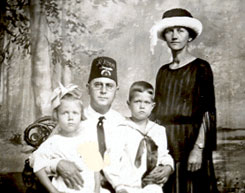
| Papa was so busy with his hundreds of patients (in one year delivering more than half of all the babies in Lorain) that he seldom could take off for a vacation. As a consequence, it was not unusual for Papa to come in from a call or the office and tell Mamma to “pack up, looks like things are a bit slack, and we will leave for Waynesburg in an hour” to visit the Meek and Waychoff relatives. It usually took us twelve to fourteen hours to travel the one hundred fifty miles so that, often, we would get into Pennsylvania after dark. The state was mountainous, with many creeks and streams following the valleys and flowing across the roads. Because there were few bridges, we frequently became hopelessly stuck, sometimes twice in the same evening. Papa would leave a revolver with Mamma, who was a good shot, and tell us all to stay put. Then he would walk to the nearest farmhouse, where he could usually find a farmer who was a Mason or Shriner. The farmer would recognize the Shrine pin Papa always wore |
|
|
|
 |
|
and would willingly bring his rig and horses to pull us out of the mud and send us on our way. It was common to get stuck at least three times each trip until about 1925 when the roads were sufficiently improved. Upon arriving in Waynesburg late at night, Papa would toss pebbles at the window where Uncle A.J. slept to wake him up. He soon got to know that it was the Meek family, so he did not hesitate to come down to open the door for us.
|
|
|
Papa loved to fish and, in 1926, bought a rowboat to use in Lake Erie to try to catch pike, pickerel or perch. He often took others out, too, such as our minister. Neither Papa nor Mamma could swim, so they were concerned about us children. The solution was to tie us around the middle with a rope, just in case we fell in; then they could pull us out. This irritated me because I was a pretty good swimmer at an early age. Besides, I was always a little worried about what I could do if either or both of my parents accidentally took a dip into deep water while we were tethered.
|
|
|
 |
|
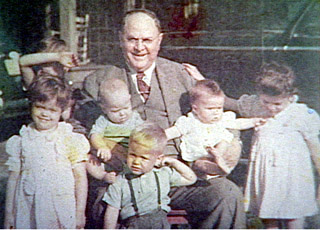
Papa maintained his love of fishing throughout his life. When his grandchildren became old enough, he often took them to the banks of Lake Erie or the Black River, where he patiently taught them to thread a worm on a hook, cast it into the water, and wait watchfully for a bite. It was one of the special ways he bonded with his smallest friends.
|
|
|
|
(1948: Papa with Barbara, Richard, Alan, David, Adrienne and Carol Ann)
|
|
In 1914, Papa joined the Knights of Pythius. When I was born, members came over to the house on East Erie and presented Papa with a petition for his newborn son. Later, Papa said many times that he should have filled out the petition to see what they would do with it. In the 1920’s, Papa would often take me up to Pythius Hall, two buildings from his office, which was then located between 7th and 8th Streets on Broadway. There, I would watch Papa beat all the brethren at billiards. He was an expert player and very much enjoyed playing with his friends.
|
|
|
|
|
|
Papa also was a skilled bowler and often took me with him when the doctors’ teams played. He was a member of the “Adhesives”. He had the most amazing slow ball I have ever seen, which astounded all the observers. The ball was thrown very slowly and would roll along the right edge of the lane right alongside the gutter. When it got within a few feet of the pins, the ball would move over to strike the head pin exactly right and give him a strike every time. But he didn’t throw it very often, depending on his fastball, instead.
|
|
Papa liked to hunt game and always had a bird dog. We had guinea pigs, chinchilla rabbits, cats and dogs around most of the time. But the bird dog, a little beagle named Fanny, was Papa’s prize. He taught Fanny to smile when he asked her. It was the funniest thing to see the little dog stretch her lips into a smile as she looked at Papa for praise. Later on, Fanny had six little pups, which were Papa’s joy, because Fanny taught all the pups to smile, too. When Papa would say, “Smile, Fanny,” all seven of them burst out with big smiles.
|
|
Papa enjoyed a good joke and occasionally liked to “put one over” on his friends. He had a large office on the second floor of the Pythius Hall building, with a large waiting room, several treatment rooms, and an adjoining office that he rented to Dr. Krause, who became our dentist. Once in a while, Dr. Krause would go hunting with Papa. Papa knew many farmers in central Ohio where the hunting was especially good. Dr. Krause and a number of other doctors went on a hunting trip with Papa one day. They stopped at a farm where Papa knew the owner and asked if he would mind if they hunted on his farm that day. Drawing Papa aside, the farmer agreed, provided that Papa would kill his pet cow, which stood in a pasture just over the hill. The farmer did not have the heart to kill the animal himself because his whole family had loved it. Papa consented to the request, and then led the group of unsuspecting doctors up the hill. All at once Papa yelled, “There’s a deer!” He aimed his rifle at the cow and fired, whereupon, the poor cow dropped over dead. The other doctors were aghast with fright and yelled at Papa, “That was no deer! You just shot the farmer’s cow!” And they raced back to the car as fast as they could go while Papa chuckled quietly to himself.
|
|
Another time, in the thirties, Papa spent a week in the mountains of Pennsylvania on a deer hunt. He caught his deer and brought it home on the fender of the Jordan, frozen because it was a cold winter. He hung the deer in the garage and proceeded to butcher it. Then, he got a call from one of his real estate broker friends who asked for a piece of venison, saying that he had never had any and would love to see how it tasted. Papa said he was just now butchering the deer and that he would send some over. Then, he sent me to the butcher shop on Oberlin Avenue two blocks from our house to buy a nice piece of sirloin steak. He wrapped it up in newspaper and had me take it over to the man. The next day, the man called Papa to thank him for the venison, adding that he had never tasted a finer piece of meat in his life. Papa replied, “That wasn’t venison you ate; it was a nice piece of steak I bought for you to hold you down until I could butcher you a piece from the deer. I will send Charles over with real venison, tomorrow.”
|
|
In 1930, Papa joined the Elks Lodge, about the time the Lorain Elks were building the Hotel Antlers, located a block off Broadway on East Erie Avenue. To pay for the building, the Elks conducted a raffle. Nobody thought much about the raffle being a bad idea until someone sent some tickets through the mail. The postal authorities caught it, and the Elks lost the hotel. They moved to the third floor of the building on the corner of 6th and Broadway. Papa became Chairman of the House Committee just before the Elks, in their new location, began losing lots of money. Upon investigating, Papa discovered that the Exalted Ruler was treating all his friends to free drinks. He put a stop to that, and the Elks were saved. The Elks Lodge soon accumulated enough money to buy a large house, formerly owned by a doctor, located on 6th Street just around the corner from their previous location. Later, in the early thirties, I had an eighteen piece dance orchestra which was designated the “Official Elks Orchestra.” We played many dances for them at the new location.
|
|
Papa not only enjoyed music and sports, but he loved to dabble in artistic pursuits, especially that of oil painting. He often made Cemantha and me pose while he drew and painted our likenesses. He painted roses all around the ceiling border of our living room, and created from memory a beautiful image of his home on the farm near Holbrook, PA that he painted in oils on the glass front of his medicine cabinet. It was remarkably realistic, looking exactly like the old farm. The house was picturesque, with the windows left unpainted so that when a light was placed in the cabinet, the windows shone beautifully, as if someone were living there. Unfortunately, it was broken when Papa moved his offices to the new Broadway building about 1928.
|
|
From the very beginning of his career, Papa’s curiosity put him in the forefront of developments and advances in treatments and medicines. While still in medical school, he and his roommate experimented with a system for electrically monitoring the flow of blood and the condition of the heart. The principles of those experiments were similar to those used in the EKG machines perfected and marketed years later. As a result of his student experiments with the methods, Papa could read the books and point out to me the mistakes in theory promoted by various writers, because he understood how to read the results.
|
|
He had such sensitive fingers that he could feel a break in a bone. I recall one day he came home and said he had just reviewed an X-ray made at the hospital which showed no breakage in a patient’s arm. He was certain he had felt a break, so he sent the patient back to the hospital to have the arm put in a different position for the X-ray; sure enough, it showed the fracture.
|
|
|
|
|
.jpg) |
|
|
|
He formulated a variety of his own baby foods for his patients’ use. One day, a drug company representative came into the office and asked him whether he had developed any baby foods lately. When Papa told him what he had created, the representative reported to his company, which then manufactured and marketed the product. When the representative returned the following year, he told Papa that, if he had only asked for it at the time, the company would have paid him ten cents a can for his formula. I always wondered why they did not give the money to Papa, anyway, if the company had been honest.
|
|
|
Charlie while in Business College, about 1910
|
|
Papa developed a new medicine for asthma that helped me very much. I had severe asthma as a youth, but outgrew it later in life. His formula combined some type of medicine with licorice, an herb that is commonly recognized today for its ability to help support the immune system. As early as 1914, Papa mixed lanolin from sheep’s wool into lotions for the treatment of skin problems; used pig skin and the skin from frogs’ bellies to cover and help heal severe burns; and created cultures of dead germs at the fireplace for vaccines to use on his patients long before such items were commercially available. He was an extremely innovative doctor, who, like the majority of dedicated physicians, was more intent on helping his patients than on marketing any products he may have developed for their use.
|
|
During the First World War, the government built a whole city of houses on the East side of Lorain for the government workers at the Ship Yard and Steel Plant, which was making bomb casings and other items for the war effort. After the war, about 1922, Mamma’s brother Challen, the District Attorney in Greene County, PA, heard that the government was about to sell the houses. So, he and Papa set up a corporation to buy all of them, but the government decided to sell the properties at auction. Papa bought only one, a duplex side-by-side, at 415 Kansas Avenue. He rented it to tenants for many years. For several years, Uncle Ross and Aunt Hildred occupied one unit. Later, during the Second World War, Dorothy and I rented a unit while I worked at the American Ship Building Company.
|
|
At the time that Papa was dickering for the houses, he took us to Cedar Point, an amusement park near Sandusky, in order to give the family an outing. Papa always loved horses and in later life enjoyed seeing sulky races at state and county fairs. At the amusement park, however, Papa had to be satisfied with playing the mechanical horse races where you turn a handle to force your horse to the line first, in order to win a prize of candy. Because Mamma objected to his playing the game on this visit, he decided to keep her busy by urging her to see a Fortune Teller who was close by. When Mamma entered, the lady immediately told Mamma that she had two children, but should have had four. This was true, because Mamma had borne two sons who died in infancy. Then, the Fortune Teller said she often saw one or two houses connected with people who came in, but when she looked at Mamma’s face, she saw a whole city of houses. Mamma never got over that revelation and repeated it many times.
|
|
In 1929, right after the stock market crash, Papa was very much concerned. Some of his friends committed suicide, and most everybody lost all their money, including Papa. He decided to write some letters to the President and Congress with plans to alleviate the problems. I helped him write some of the letters, so I have firsthand knowledge of what went on. Banks were foreclosing on homes all over the nation. Papa devised a plan, which later became the Federal Home Loan Finance Corporation, to save many people’s homes throughout the nation; a plan for employee incentives and bonuses, including employee shares in profits, which was first adopted by the Jack Heinz Company in Cleveland; and several other plans, all sent to President Hoover. On one of the letters, Papa wrote that his plan was “potent pills for the nation's ills” and received several letters back from the government expressing their appreciation to him for his plans. Hoover took several of Papa’s plans to Congress, which voted them all down because the Democrats would not support Hoover. However, as soon as Roosevelt assumed office, all of Papa’s plans were reintroduced to Congress and all were approved. Roosevelt received the credit for all of them. But, in one national review, appearing in all newspapers of the time, the phrase “potent pills for the nation's ills” was prominent in their articles.
|
|
|
|
|
 |
|
|
|
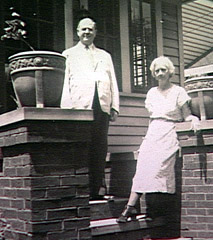
After the stock market crash, Papa could not find enough money to stay at the Broadway Building, so he moved his office to the second floor of our house on Hamilton Avenue. He was extremely concerned about his patients, whom he loved, and often bought them coal for their furnaces, and blankets to keep them warm, until he ran out of money. People ran up big bills with Papa, and he canceled much of the bill if he felt his patients could not afford to pay. We often lived on farmer’s produce used to pay for Papa’s services instead of money. To this day, some of his grandchildren still retain items that were given to him in lieu of payment, such as embroidered dresser scarves and even a Civil War pistol. I saw him many a time with only five cents in his pocket, and he would say, “I might as well have nothing as to have a nickel”. Then he would go out and buy a cigar to relieve his tension.
|
|
|
I only saw Papa cry once. It happened after the great Lorain tornado in 1924. A representative of the Red Cross came to visit shortly after we had returned to our repaired house. The woman who conducted the interview apparently thought that every doctor was wealthy, so she recommended that no help be given to Papa. He came home one day shortly thereafter with tears in his eyes and said he was finished. He asked Mamma what he could do, for he was just getting a good start as a doctor and had no resources. Mamma told him to go see the top authority of the Red Cross and explain matters to him. In a couple of days, the Red Cross did help Papa get back on his feet.
|
|
|
 |
|
|
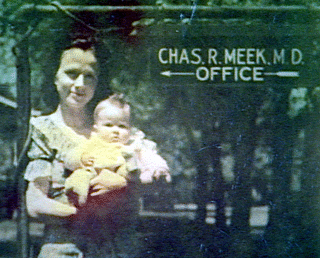
(544 Hamilton Avenue: additions were made in the late 1940's)
|
|
|
Jane with Dennis Michael, about 1950
|
|
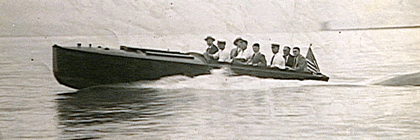
About 1931, Papa somehow managed to buy a speedboat, something that he had always wanted. Bought at a distress sale, it was a fine boat--very much like a Chris Craft, but with an OX5 airplane engine in it and a Nipert bow that impressed Papa very much. There was much discussion at home on what to name the boat. I finally suggested the name “Lorainbow.” They liked it and painted it on the bow and stern. Papa got permission from the city to construct a platform off the east break wall at Lake View Park from which we could run speedboat rides. I was the purser during the summer of 1932. Mr. Bartenfield was hired to run the rides and was warned to be very careful not to come in too close to shore on the turn into the platform because there was a large rock there. Sure enough, one day he came in and hit the rock, ripping off the propeller. Papa fired him, repaired the boat, and hired Spencer Stevens as the new boat pilot. Spencer was the son of one of Papa’s patients.
|
|
| We made only a little money that summer. The weekend of Labor Day, Papa told Spencer we were closing up shop and were going to go fishing on that Sunday morning. What we did not know was that Spencer had been smuggling booze in from Canada at night and carrying it right past the Coast Guard Station to our dock just below the bascule bridge on the Black River. The motor on the boat was extremely quiet, which allowed him to sneak in. When Papa closed up shop, Spencer’s business was cut off, a fact that he resented. It rained that Sunday morning, so we did not go down to the |
|
|
|
|
 |
|
|
Papa's Speedboat, 1932
|
|
|
boat. About 9:30 a.m., Papa got a call from the Coast Guard that our boat had sunk to the bottom of the river. There had been explosions at both bow and stern, which caused a fire. The Coast Guard threw water into the boat to put out the fire and managed to sink it. Upon investigation, it was found that Spencer Stevens had been seen on the bridge about 8:30 a.m. and stayed around for quite a while, apparently until the boat had sunk. Then, Spencer disappeared for parts unknown. If it had not rained that morning, it is likely that our whole family would have been murdered.
|
|
A year later, a man who ran a little magic shop in Lorain, was murdered. The police caught the culprit; it was Spencer Stevens, who had killed the proprietor for money. The shopkeeper was lying on the floor of his shop with one shoe off. The police determined later that he had kept his money in his shoe. Spencer committed murder for the grand sum of $10.00.
|
|
In 1936, Papa wanted a new car, so we took the Coupe to the Buick garage and put it in the corner. The owner said, “Doc, why not take one of my Buicks on a long drive to satisfy yourself that it is one of the best cars around?” So Papa agreed and said that he was planning to drive down to Waynesburg to visit his relatives. The owner said, “OK.”
|
|
That afternoon, we piled into the Buick and started off. Instead of going toward Pittsburgh, which we normally did, we cut south to travel along the Ohio River. As we were coming down a long hill that had a curve half way down, we saw a young girl standing along the edge of the highway thumbing a ride. Traffic was very heavy ahead of and behind us. Just as we passed the girl, the car that was two cars ahead decided to stop and pick her up. The car behind him was traveling too fast to stop and crashed into him. Papa saw it happening and slammed on the good brakes of the Buick, stopping safely a few feet behind. Papa yelled to Mamma, sitting in the back seat, to brace herself just as the car behind us smashed into our car. The crash ruined the back end of our car, twisting the bumper up over the roof and pushing us into the car ahead. The driver behind us also had had his eye on the girl and did not see us in time to stop. Cemantha and I were not hurt, but poor Mamma quietly said, “Charlie, I think I have broken my arm.” A record player we were carrying back for Aunt Oma was in the back seat with Mamma; it had become dislodged and had struck her arm. Mamma was never one to complain much about anything, though. She was always placid and sweet. Despite the damage, the Buick still operated, so we finally drove on.
|
|
|
When we returned to Lorain, the owner of the auto dealership told Papa not to worry because his business had enough insurance to take care of the damage. He mentioned, however, that none of his mechanics could start the Jordan Coupe. Papa told me to go over and start it up. I did so with no problem, much to the surprise of the garage personnel. It was necessary to hold the gas pedal down at a precise point for it to start. No one but Papa and I knew how to do it. Papa did not buy a Buick that day, but bought a new 1936 Jordan sedan, instead. I spent the next two years at college driving the old 1928 Jordan sedan.
|
|
About this time, fluoride became the topic of the day. Many of the doctors wanted to put it into the water supply, believing it would help lower the incidence of tooth decay in the general public. They were holding a county medical meeting, so Papa stayed up nearly all night writing a rebuttal against the idea. The basis of his objection was that fluoride accumulated in the body and would cause bones to become brittle, which would be especially detrimental to older people. He advocated the insertion of fluoride in toothpaste so that it would be absorbed only in the teeth. After these many years, there is general agreement in the medical field that Papa’s views were correct.
|
|
|
About the same time, six doctors were called to a conference at the hospital to consult about a patient with some kind of rare disease. Papa examined the patient and then told the doctors that he would put his diagnosis in an envelope and give it to a nurse, stating that it should be opened only after all of the others had decided the nature of the disease and its proposed treatment. The other doctors decided to wait for three days until the patient’s test results were announced. After three days, they all agreed on diagnosis and treatment and the envelope was opened. Papa had given the right diagnosis and treatment from the outset. He felt it was a shame to withhold medicine for the poor fellow for three days, when the very same medicine would have been given for all four possibilities they had been considering. The others, however, had to know exactly what it was before giving any medicine, regardless. Papa would have had the patient up and out of bed by the third day.
|
|
Papa served as President of the St. Joseph Hospital Staff and lectured in Obstetrics to the Nursing School of the Hospital for eight years; Chief Surgeon for Casualty Station No. 1 in 1942 and many years afterward; Chief Examiner for the Selective Service Board No. 2 in Lorain County from 1941 and after; and served on the Emergency Medical Staff of the Hospital for over twenty years.
|
|
In 1915, Papa joined the Masonic Fraternity, but did not advance to the York Rite until 1932. That year, during the summer, the president of a small electric steel company in Cleveland got sick on a small boat just as it was passing Lorain Harbor. He was referred to Dr. Meek, who took care of him. That patient was Paul Lutz, a very active Royal Arch Mason, who was later the Grand High Priest and then Grand Secretary. He liked Papa right away and passed the word that Papa would make a wonderful officer, who likely would cure the problems that the Chapter of RAM was having. On the next election night, Papa was not in attendance. But he received a call from one of the members who told Papa that he had just been elected to one of the Veils in the Chapter. Would he accept? Papa said, “Sure.” They did the same thing in the Commandery of Knights Templar the following week, and again he said, “Sure.” I had the privilege of joining the Chapter of RAM while Papa was High Priest. As a Past Commander and Past High Priest, Papa installed me as both High Priest and Commander in 1955.
|
|
He was a Grand Representative of the Grand Chapter of Minnesota near the Grand Chapter of Ohio; member of Al Koran Shrine, Cleveland; Past Commander’s Association; Council of Anointed High Priests; Official Lecturer of the Lorain County Medical Society on legislation affecting the medical profession in 1943; a Scottish Rite Mason; member of the yacht club; twice President of the Lorain County Medical Association; member of the Ohio State Medical Association; a Fellow of the American Medical Association, the North American Post Graduate Assembly, and the International Congress of School Hygiene; a Delegate from Lorain County to the Ohio Medical Association from 1930-1946; and Delegate from the Ohio Medical Association to the American Medical Association from 1940-1946. At this time, the College of Surgeons had control of the AMA, so Papa became very instrumental in starting the Academy of Internal Medicine of the AMA.
|
|
|
He was also the author of the “Meek Plan” for medical and hospital care of the indigent sick, which was adopted by the city of Lorain and the County Commissioners of Lorain County, Ohio. The plan was accepted by the Ohio State Medical Association and, from there, recommended throughout the country.
|
|
|
Papa was most proud that none of his patients had lost a finger or a toe. Many patients had accidentally cut them off, but brought them into the office where Papa sewed them back on. They were all in working order.
|
|
Papa’s love of music began very early in life. His mother, Nancy Loar Meek, was a very good singer and sang often in church. His father determined that Papa’s sister Velma should receive piano lessons, but considered that music was not for boys. Nonetheless, Papa was the only one of the children truly interested in music; so, when Velma received a lesson, Papa would hide behind a door and listen. Then, when no one was near, he would go to the piano and practice the lessons his sister had received. Papa became a fair piano player and loved to play in later life when he had time. He was particularly interested in the violin, but had no opportunity to learn to play it until his roommate in medical school taught him some of the rudiments.
|
|
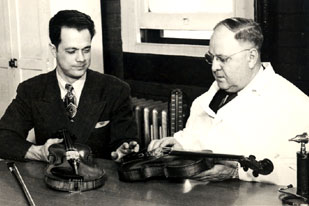
As an adult, Papa combined his interest in the violin with his love for working with wood. He prepared all the wood from floors to ceiling in the house with loving care. But his most remarkable achievement was in the making of excellent violins with a true Cremona tone quality.
|
|
|
|
|
 |
|
|
|
|
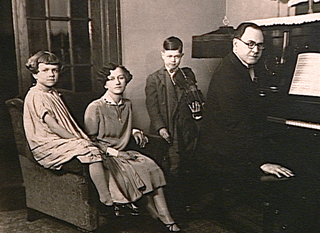
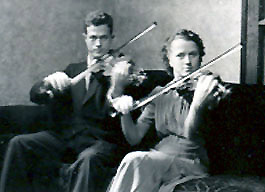
His interest in the violin was renewed when I started violin lessons with Mr. Kuzinsky when I was 8 years old. Soon, he left to become a symphony conductor in Iowa, so Papa started both my sister and me with Miss Yanula Canalos, a fine teacher for young people. She said we needed better violins, so Papa went to the music store. The owner agreed to supply Miss Canalos with five violins to try out in order to select the best ones for us. Papa did not tell her that he mixed up all the prices for the various instruments. She selected as the best, two violins that were in the lowest real price range, but had the highest tags. This caused Papa to try to figure out what made a violin greater and more high-priced than others.
|
|
 |
|
|
 |
|
|
|
 |
|
|
Charles and Cemantha Jane
|
|
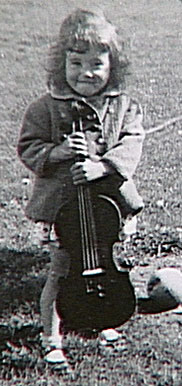
Carol Ann
|
|
He bought several books on violin making and determined that no two Stradivarius instruments were calipered alike; also, the varnish used was soft and could be rubbed out easily, even after two centuries. Papa made a written record of the type of tools they used in those days and used his medical knowledge to determine the chemistry they knew in that period. He got some pine and started to make a violin using only those tools. Then, he developed a varnish that reacted just like the one used on the best violins. His varnish, he discovered, did not inhibit the tone quality in any way. The pine violin was satisfactory in every respect, except that it did not quite have the Cremona tone.
|
|
|
|
|
|
 |
|
|
|
 |
|
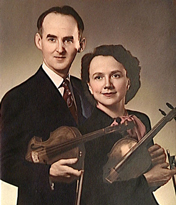
Determined to perfect the tone, he ordered from a New York City music house some old, seasoned European spruce, salvaged from destroyed houses more than a hundred years old. This was the true Tyrolean spruce of the same type used by the Cremona masters. The salvaged spruce came from a time period in which weather conditions made the wood denser than what is found today. Also, spruce from the Tyrolean Mountains in Europe is a different variety than American spruce. It does not have pitch in its fibers, so when it ages, the wood cells remain pure. It then resonates without hindrance. The first violin he made from this European spruce was excellent. It took about seven months to make it with great care. Instead of making the outside of the belly first and then calipering the inside, he determined that Stradivarius must have laid out the inside first with a flat center, and then shaped the outside with those tools to draw down the measurements to give the proper pitches when holding the node points and striking the belly. No two instruments were alike, because every piece of wood was different. He did the same with the maple back and then assembled the ribs and purfling, set the neck, and varnished it with ten coats, all hand-rubbed. They looked beautiful and had a truly wonderful tone quality. He made one for each of his sons and daughters (including the in-laws), for most of his grandchildren, one for Professor Arcule Sheesby at Northwestern University in Evanston, Illinois, and for others. He made about eighteen in all.
|
|
|
Mary Egan
|
Kenneth and Jane Egan
|
|
|
 |
|
|
|
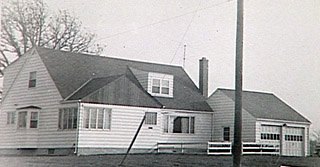
1201 Euclid Avenue (1952)
|
|
|
He took a great interest in his grandchildren. He helped us when we built our new house on Euclid Avenue and shot baskets with Richard at our back yard hoop. I remember Richard throwing the basketball to Grandpa who was standing quite a way from the hoop. Richard taunted him to make a basket. Papa took aim and threw it perfectly through the hoop. When Richard dared him to do it again, Papa said there was no use doing it twice; he had just shown Richard he could do it anytime he wanted.
|
|
 |
|
On the evening of August 1st, 1958, he shot arrows with the children and they had a great time. The next morning, he got up fairly early, but sat immediately into his chair and called Nettie. When she came in, he gasped “Nettie” once more and passed out. The great doctor died of a massive heart attack on the morning of August 2nd, 1958.
|
|
|
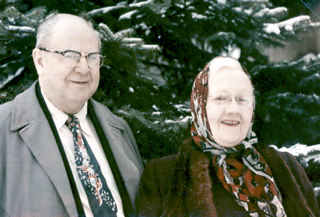
- Charlie and Nettie (1958)
|
|
|
The funeral director, Mr. Schwartz, took him to the Waynesburg Memorial Gardens in the hearse, which we followed in our car. As we rounded a curve about ten miles out of town, the tail pipe on the hearse dropped off. When we all stopped to fix it, the Director apologized. I told him not to worry about such a matter and reminded him that Papa had always met the difficulties of life with patience and fortitude. We should do no less for him.
|
|
|
|
|
|
 |
|
|
|
|
|
|
|
|
|
|
|
|
|
|
|
|
|
|
|
|
|
|
|
|
|
|
|
|
|
|
|
|
|
|
|
|
|
|
|
|
|
|
|
|
|
|
|
|
|
|
|
|
|
|
|
|
|
|
|
|
|
|
|
|
|
|
|
|
|
|
|
|
|
|
|
|
|
|
|
|
|
|
|
|
|
|
|
|
|
|
|
|
|
|
|
|
|
|
|
|
|
|
|
|
|
|